Lattice Field Theory (LFT) is a computational approach used in theoretical physics to study quantum field theories—most famously Quantum Chromodynamics (QCD), the theory of quarks and gluons.
In LFT, space-time is replaced by a discrete grid (a lattice), which makes it possible to simulate particle interactions using powerful supercomputers. This framework enables first-principles calculations of hadron masses, decay constants, form factors, and many other key quantities in particle physics.
LFT was born from the seminal idea introduced by Kenneth Wilson in the 1970s, who realized that discretizing space–time provides a non-perturbative definition of gauge theories.
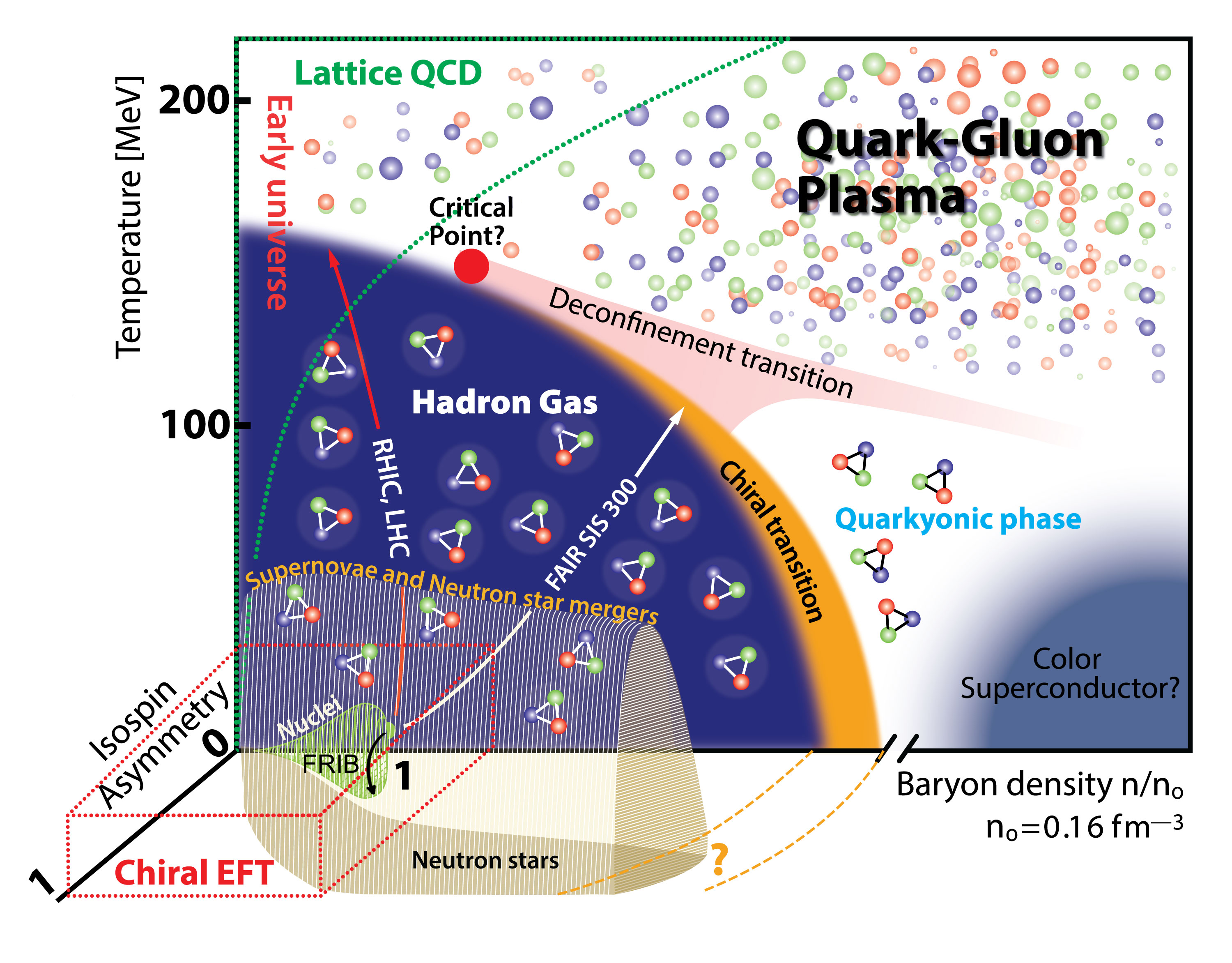
Over the past decades, lattice QCD has become a unique tool for studying the dynamics of the strong interactions non-perturbatively and from first principles. Precision lattice calculations—leptonic decay constants, semileptonic form factors, neutral-meson mixing matrix elements and mass differences, among many others—have become essential for interpreting key experimental measurements in flavour physics, determining CKM matrix elements, and placing stringent limits on physics beyond the Standard Model. They have been central to landmark results such as the validation of the CKM quark-flavour mixing pattern, the determination of CP violation in the weak (quark) sector of the Standard Model, and the interpretation of the muon 𝑔 − 2 anomaly.
In searches for physics beyond the Standard Model, lattice calculations provide the non-perturbative matrix elements and hadronic inputs that define the theoretical reach of experimental searches, while new measurements continually shape and drive the next generation of lattice computations. Lattice methods are also yielding increasingly accurate predictions for the properties of the Quark–Gluon Plasma, from its equation of state to fluctuations of conserved charges, the effects of strong electromagnetic fields, hadronic dissociation, transport coefficients, and real-time dynamical phenomena, including studies at finite baryon density. Progress in each of these areas is crucial for interpreting heavy-ion collision experiments without model-dependent assumptions.
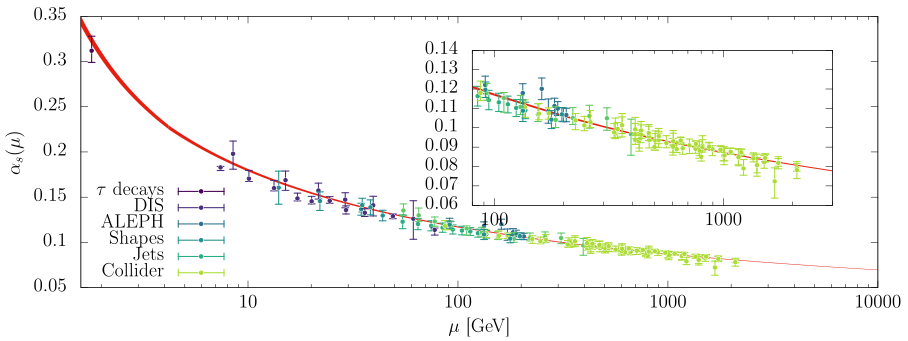
As a consequence, the interaction between Lattice Field Theory and experimental particle and nuclear physics has evolved from a loose connection into a tightly coupled, mutually reinforcing synergy. This interplay has matured to the point where lattice predictions and experimental data are now analysed side by side, each guiding the other. Often LFT provides the non-perturbative inputs that determine the theoretical reach of experiments, while new measurements in turn drive further lattice improvements required to fully exploit the experimental potential.
To keep pace with the experimental progress expected in the next decade, the lattice community continuously strive to access the most powerful HPC systems, develop new high-performance algorithms, and maintain highly parallel codes capable of running efficiently on present and future supercomputers.
Links
Learn more about lattice field theory
LaVA
The Lattice Virtual Academy (LaVa) provides introductory online lectures on topics in LFT.
Quantum Fields on a Lattice
István Montvay & Gernot Münster ISBN-13: 978-0521404327 A comprehensive treatment of lattice field theory, covering gauge fields, fermions, algorithms, and numerical methods.
Lattice Gauge Theories: An Introduction
H. J. Rothe ISBN-13: 978-9812560629 A mathematically rigorous introduction to the foundations of lattice gauge theories, including gauge invariance, lattice actions, path integrals, and continuum limits.
Lattice Quantum Chromodynamics: Practical Essentials
Carleton DeTar & Steven Gottlieb ISBN-13: 978-9402409970 A modern, concise guide to the practical and algorithmic aspects of lattice QCD simulations.
Lattice Methods for Quantum Chromodynamics
Thomas DeGrand & Carleton DeTar ISBN-13: 978-9812567277 An applied introduction emphasising spectroscopy, fermion formulations, simulation workflows, and computational strategies.
Quantum Chromodynamics on the Lattice: An Introductory Presentation
Christof Gattringer & Christian B. Lang ISBN-13: 978-3642018497 A pedagogical introduction to lattice QCD, covering the theoretical foundations, fermions, gauge fields, Monte Carlo methods, and hadron spectroscopy.
Related organisations:
-
International Lattice Data Grid (ILDG): Defines standards for data sharing in LFT
-
USQCD Collaboration: Representing the majority of LFT research in the USA